
Volume 56
2026
.jpg)
The elusive Tree Mouse Pogonomys sp.: Insights into distribution and ecology from field observations
John Winter, Patrick De Geest, Scott Burnett and Conrad J. Hoskin
The Tree Mouse Pogonomys sp. was not recorded live in Australia until 1974, although it was known from the fossil record. It is substantially under-recorded in standard fauna surveys because it is loath to enter traps on the ground. However, there have been many casual sightings of the species, and these have generated the body of information presented here. Along with the few museum specimens, such sightings indicate that the Tree Mouse occurs in rainforests of Cape York Peninsula and the Wet Tropics. It nests in burrows but spends its time arboreally, in low vegetation to the upper canopy. Observations reported herein suggest the species is primarily a fruit and leaf eater. Casual observations by citizen scientists will continue to be an important source of information for this little-known species, so we provide guidelines on the most useful details that they should collect.
Image credit: Gary Wilson
pp. 1-12

Spectacled Flying-foxes (Pteropus conspicillatus) feeding in broad daylight
Matthew Mo, Maree Treadwell Kerr, Sera Steves, John A. Allcock, Keiko Osawa and Yushi Osawa
Diurnal feeding was observed in a small colony of Spectacled Flying-foxes (Pteropus conspicillatus) in a fig tree (Ficus sp.) in Cairns, northern Queensland. Diurnal feeding has generally only been observed in flying-foxes during periods of food shortages, but these individuals did not exhibit any observable signs of emaciation.
Image credit: Matthew Mo
pp. 13-15

A biodiversity survey of a remnant semideciduous forest at East Barron, Atherton Tablelands
David Y.P. Tng, Elizabeth M. Carlson, Sophie H. Colbert, Gray W. Dallaire, James R. Leone, Jalynette Sanchez, Caelon J. Shugrue, Ellery C. Stanzel, Caroline C. White, Dominika P. Zdziebko, Camryn E. Zoeller, Benjamin M. Gravel, Stella L. Lindbergh, Deborah M.G. Apgaua, Mia A. Derhé, Sigrid Heise-Pavlov, Joshua D. Stephenson, Mairin L. Rogers, Donald M. Farrow III, Victoria I. Nazarov, Victoria F. Holman, Will Cairns and Andi Cairns
“Mabi forests” are endangered and highly fragmented tropical semideciduous forests that occur on basalt-derived soils in the upland regions of the Atherton Tablelands, Queensland. While Mabi forest flora and fauna are generally well-described, species lists of localised remnant patches, which can provide important information for landowners managing such patches, are lacking. We studied an eight hectare (21 acre) privately-owned Mabi forest remnant in East Barron between late March to mid-April 2025. We surveyed vascular and non-vascular plants, conducted leaf litter collections and baited pitfall trapping for ground invertebrates, and light-sheeting for nocturnal invertebrates. To survey birds and other vertebrates we undertook non-intrusive daytime and nighttime observations. To complement our dataset, we compiled the available bird and mammal data for the patch from the Atlas of Living Australia. The combined plant and animal diversity documented is significant considering the small size of the Mabi forest patch, and included bryophytes (33 spp.), ferns (15), flowering plants (152), invertebrates (192), birds (123), other vertebrates (12), protozoans (3), protists (1), and fungi (66). Of these, at least 14 plant and three animal species are of conservation significance in Queensland. Although the sampling was intensive, some groups of organisms such as fungi and invertebrates remain under-represented, and our survey data should be considered as a snapshot of the biodiversity of these groups. We conclude that remnant forest patches can provide important habitat for multiple species, and we recommend similar surveys of other Mabi forest localities and remnants of other forest types on the Atherton Tablelands to better understand the distribution of native biodiversity in these habitats.
Image credit: David Tng
pp. 16-34
.jpg)
Conservation of the Ghost Bat Macroderma gigas in central Queensland
John Toop, James Davie, Lana Little, John Augusteyn and David Gillieson
This article details legacy fieldwork (1975–1988) by the late John Toop to document the dynamics of the Mount Etna (central Queensland) Ghost Bat Macroderma gigas colony. John Toop’s work on the Mt Etna Ghost Bats provided empirical data for the first time on the ecological requirements of this species and raised awareness of what has been confirmed to be the significant downward trend in the local population. The findings from this original work included confirmation of the crucial connection between cave architecture, retention of heat and humidity and the survival of young Ghost Bats; description of the seasonal movements of this population, largely as dictated by the above; description of the common suite of prey; discovery that the average body mass of adults from the Mt Etna colony is greater than the recognised weight range for the species; discovery that the average gestation period in the Mt Etna colony was longer than recognised for the species; indications that breeding pairs were barely achieving replacement levels; and crucially, the first reliable indications that the local population of Ghost Bats was declining. Thanks to the pioneering work done during this study, current conservation management aims to minimise disturbance of the bat colony at critical stages of its life cycle and to preserve foraging habitats adjacent to the limestone outcrops.
Image credit: John Toop
pp. 35-51
_JPG.jpg)
A terrestrial vertebrate fauna survey of Konomie (North Keppel Island)–March 2023
John Augusteyn, Andrew McDougall and Johanna Karam
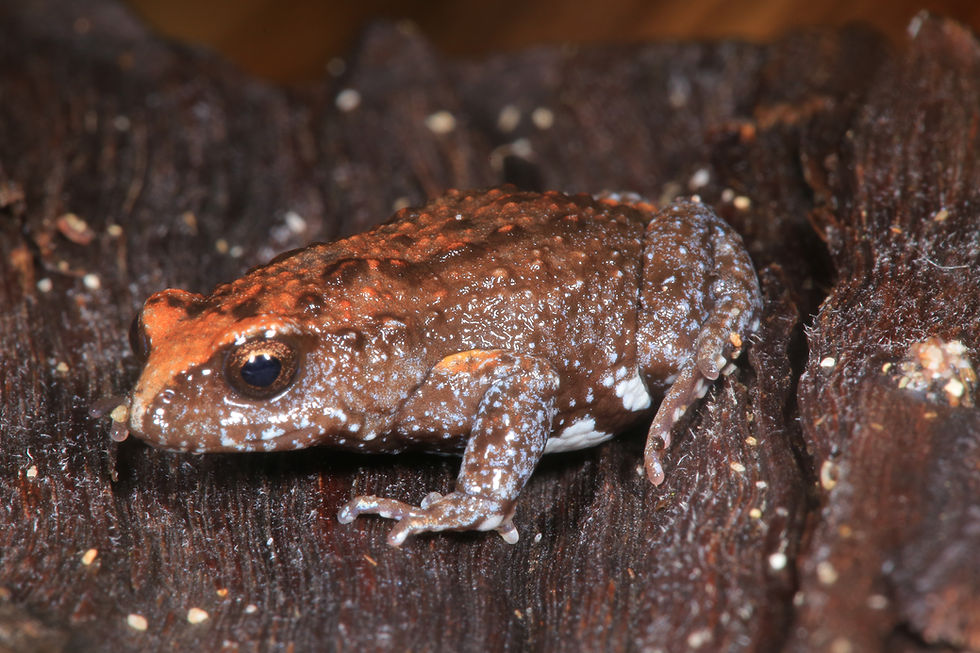
The Queensland Parks and Wildlife Service (QPWS) conducted a fauna survey on Konomie (North Keppel Island) in March 2023. The survey aimed to enhance understanding of the island's vertebrate fauna and identify management concerns. A total of 69 terrestrial vertebrate species were recorded, including 25 species not previously documented in WildNet, raising the overall terrestrial count to 137 species. Among these were one threatened species, the Vulnerable Beach Stone-curlew (Esacus magnirostris), and three species classified as Special Least Concern: the Eastern Osprey (Pandion haliaetus cristatus), the Whimbrel (Numenius phaeopus), and the Spectacled Monarch (Symposiachrus trivirgatus) (under the Queensland Nature Conservation Act 1992). Two voucher specimens were collected to assist with the taxonomic review of the Great Brown Broodfrog (Pseudophryne major), which exhibited some variation in call behaviour compared to mainland populations. The introduced Black Rat (Rattus rattus), Common Brushtail Possum (Trichosurus vulpecula) and introduced Common Myna were recorded. These species are known to negatively impact native flora and/or fauna; their control is recommended. Low intensity mosaic burning, during periods of high soil moisture, is also recommended. It will minimise the risk of exacerbating the impacts of these introduced species by ensuring the retention, and rapid recovery, of habitat and shelter.
Image credit: John Augusteyn
pp. 52-63
_JPG.jpg)
A terrestrial vertebrate fauna survey of Percy Isles National Park–October 2023
John Augusteyn, Bridget Armstrong, Carly Greig, Brett Turnbull, Johanna Karam and Anthony Dean
A terrestrial vertebrate fauna survey of Percy Isles National Park (predominantly South Percy Island) within the Great Barrier Reef and Marine Parks Region was undertaken in October 2023 to improve knowledge of the islands’ fauna and identify any management concerns. A total of 73 terrestrial vertebrate species were recorded, including 43 not previously listed in WildNet, increasing the park’s total recorded fauna to 101 vertebrate species. One threatened species, the vulnerable Beach Stone-curlew (Esacus magnirostris), and four Special Least Concern species – the Eastern Osprey (Pandion haliaetus cristatus), Whimbrel (Numenius phaeopus), Spectacled Monarch (Symposiachrus trivirgatus), and Crested Tern (Thalasseus bergii) – were documented. Twenty-one voucher specimens or DNA tissue samples were collected to confirm species identity and support taxonomic or population genetic studies. Feral goats and two introduced macropod species were recorded on Middle Percy Island and were having considerable impacts on vegetation and associated habitat values at the time of the survey, while Lantana camara, Passiflora foetida, and Opuntia sp. were present but not considered to be significantly affecting fauna values.
Image credit: John Augusteyn
pp. 64-74
.jpg)
A vertebrate fauna survey of Lizard Island National Park (CYPAL)–August 2023
John D. Augusteyn, Harry B. Hines and Karl Goetze
The study aimed to improve knowledge of Lizard Island's terrestrial vertebrate fauna and identify management concerns. Sixty-two terrestrial vertebrate taxa were recorded during a survey conducted in August 2023, including 15 species not previously listed for the island in WildNet, taking the total terrestrial vertebrate species count to 143. One threatened species, the Vulnerable Beach Stone-curlew (Esacus magnirostris) and six Special Least Concern species were recorded, including the Eastern Osprey (Pandion cristatus), Lesser Frigatebird (Fregata ariel), Common Sandpiper (Actitis hypoleucos), unidentified Gallinago snipe, Black-naped Tern (Sterna sumatrana) and Crested Tern (Thalasseus bergii). Over 30 voucher specimens or DNA samples were collected to confirm the identity of species or to contribute to taxonomic and/or population genetic studies. One introduced fauna species, the Asian House Gecko (Hemidactylus frenatus), and invasive Guinea Grass (Megathyrsus maximus) were recorded. These are considered management concerns. Adherence to island biosecurity measures is critical to maintaining Lizard Island's biodiversity values.
Image credit: John Augusteyn
pp. 75-87
.jpg)
A vertebrate fauna survey of Flinders Group National Park (CYPAL) – August 2022
John D. Augusteyn, Harry B. Hines, Andrew R. McDougall and Chris Billett
A fauna survey of Flinders (Wurriima) and Stanley (Yindayin) Islands in the Great Barrier Reef was conducted in August 2022 to enhance understanding of the islands' fauna and identify management concerns. The survey recorded 72 terrestrial vertebrate species, including 30 species not previously documented in the island group, bringing the total terrestrial vertebrate species count to 118. Notably, the Faint-Striped Blind snake (Anilios broomi) and the Striped-tailed Delma (Delma labialis) were found near or beyond their known distribution limits. Two threatened species were identified: the Endangered Bare-rumped Sheathtail Bat (Saccolaimus saccolaimus nudicluniatus) and the Vulnerable Beach Stone-curlew (Esacus magnirostris) (Queensland Government Nature Conservation Act 1992). Additionally, four Special Least Concern species were recorded: the Lesser Frigatebird (Fregata ariel), Nesting Eastern Osprey (Pandion haliaetus cristatus), Caspian Tern (Hydroprogne caspia), and Crested Tern (Thalasseus bergii). The Near Threatened Coastal Sheathtail Bat (Taphozous australis) was also recorded. Fifty-one voucher specimens or DNA samples were collected to confirm species identities and contribute to taxonomic and population genetic studies. While no species of management concern were detected, the high diversity of limb-reduced lizards and their frequency of occurrence should be considered in fire management planning to ensure the maintenance of adequate refugia. No signs of feral cats, goats, or pigs, previously recorded on the islands, were found during the survey. The introduced Black Rat (Rattus rattus) was present, but its numbers and impacts were deemed low. The species recorded in this survey were comparable to those documented in previous surveys, suggesting that the fauna communities on the islands are likely stable.
Image credit: John Augusteyn
pp. 88-99

Germinated seedling assemblage beneath Metallic Starling (Aplonis metallica) nesting tree at Lockerbie Scrub, Queensland
A. J. Bean
In March 2022, seedlings under a Metallic Starling nest tree in Queensland were counted. The dominant species included Antiaris toxicaria subsp. macrophylla and Canarium australianum. Results support the idea that seeds accumulate near colony trees and may aid rainforest recruitment, though direct dispersal attribution is limited. This provides field evidence for seed germination after passage through starlings and emphasizes the need for replicated studies.
Image credit: A. J. Bean
pp. 100-102