
Volume 55
2025

Australian Bee-eater Merops ornatus swallowing stones
Angus Emmott and Clifford B. Frith
Bee-eaters, of the Family Meropidae, are known to ingest small pieces of grit as gastroliths and while a few anecdotal reports of them eating slightly larger gastroliths exist, documented evidence is lacking. A Rainbow Bee-eater was photographed swallowing a small stone, possibly for the first time, and this is reviewed and discussed.
pp. 1-2
Image credit: Angus Emmott

James Andrew (Jim) Bravery, 1896–1975: miner, soldier, farmer and an outstanding field ornithologist on the Atherton Tablelands, far north Queensland
Elinor C. Scambler
Observers using field glasses, not shotguns, made pioneering contributions to regional ornithology in the 20th century, but their lives and influence have received little attention in Queensland. James Andrew Leslie (‘Jim’) Bravery, a young coal miner from south-east Queensland, was interested in birds and conservation by age 14, although he never collected eggs and no other family members were naturalists. After serving in WWI, he moved to the Atherton Tablelands as a soldier-settler and farmed there for the rest of his life. The most probable influence on his early development as a field ornithologist was the ‘new curriculum’, which introduced nature study to Queensland primary schools for his last four years of education, at ages 9–12. The nature study movement encouraged children to observe wildlife for themselves, and to form a personal commitment to nature. After recording birds and their behaviour on the Atherton Tablelands for nearly 40 years, at age 60 Bravery joined ornithological societies and began corresponding with leading naturalists including A. H. Chisholm and K. A. Hindwood, who encouraged him to write. Bravery’s articles, particularly his 1970 signature paper on birds of the Atherton Shire, have attracted more than 1000 citations in published literature and continue to provide a baseline for studies of birds and their conservation in the region.
pp. 3-21
Image credit: Courtesy M. Muoio.

A snapshot of diversity – a North Queensland BioBlitz exploring plant and animal diversity at a reforested urban park in Malanda, Atherton Tablelands
Anne G. Heiser, Susanna R. McDowell, Dylan Berr, Sydney A. Sharp, Emma Garman, Mia Martin-Fuller, Vanessa Norris, Anya Hoepfinger, Iris Ballard, Deborah M.G. Apgaua, Donald M. Farrow III, Victoria I. Nazarov, Victoria F. Holman, Mia A. Derhé, Nigel I.J. Tucker, Angus Emmott, Alan Gillanders, Gemma Horner, Stuart J. Worboys, Renier Van Raders, Amanda N.D. Freeman, Alastair Freeman, Peter S. Valentine and David Y.P. Tng
Bioblitzes are public events that engage the community and stimulate learning about the natural environment. On 9 November 2024, a bioblitz was held in Dungavel Park, Malanda, Qld, which is a public park with open areas and a narrow, revegetated riparian corridor replanted 20-25 years ago. During the event, which was attended by c. 300 people, experts and public participants were invited to make and submit observations of biodiversity over a period of 24 hours. A research team from the School for Field Studies and various specialists of different groups of biodiversity also conducted targeted surveys of plants, invertebrates, birds, reptiles and amphibians throughout November. We documented a total of 461 species, which included 262 species of plants including algae (1 spp.), bryophytes (12 spp.), ferns (11 spp.), gymnosperms (3 spp.) and flowering plants (235 spp.). Of the 249 vascular plants, 169 species were native, while 80 species were non-native. We also recorded 14 species of lichen, three of macrofungi, 107 of invertebrates, and 75 species of vertebrates. Although the sampling effort was intensive for only a limited time, the data collected should be considered a snapshot of the biodiversity of the site. Some groups of organisms, such as non-vascular plants, fungi, invertebrates, fishes and mammals remain underrepresented. Nevertheless, the plant and animal diversity documented is significant considering the highly modified environment at the bioblitz site and that most of the observations were recorded from the riparian strip. We conclude firstly that older revegetated rainforest patches, even when subject to heavy anthropogenic use, can provide important habitat for native biodiversity. Secondly, bioblitz events are useful initiatives for documenting local biodiversity, engaging the public, and promoting educational outreach about nature. Finally, we recommend organising similar events for other localities and habitat types within the Australian Wet Tropics to document and spread awareness about local biodiversity, and we hope that this work presents a useful example of how biodiversity data from future bioblitzes can be reported.
pp. 22-39
Image credit: Dylan Berr

Bryophyte diversity in a remnant upland rainforest on the Atherton Tablelands, Queensland, Australia
David Y.P. Tng, Camilla J. Mancini, Zoe C. Strothkamp, Aidan T. Nelsen, Sophia M. Love, Emily A. Bischoff, Victoria F. Holman, Emma Osmond, Andi Cairns, David Meagher and Deborah M.G. Apgaua
Bryophytes are an important but neglected component of the flora of the Australian Wet Tropics bioregion. In particular, the bryophyte flora of complex notophyll vine forest 5b, also known as Mabi forest, that occurs on fertile basaltic soils in the upland regions of the Atherton Tablelands, Queensland has not been thoroughly examined, despite the endangered status of this forest type. To address this information gap, we collected bryophytes using a floristic habitat survey method where we sampled a wide range of microhabitats and substrates in a ~6 ha patch of Mabi forest within Hallorans Hill Conservation Park, Atherton. We collected 202 bryophyte specimens, and identified 44 species of moss, 41 species of liverworts, and two species of hornworts. Substrates included tree bark and twigs (epiphytic – 66.7% of bryophyte species), rock (epilithic – 41.4%), decaying logs (epixylic – 31%), soil (terrestrial –12.6%), and on leaves (epiphyllous – 3.4%). Around 30% of species occurred on multiple substrates. The high bryophyte diversity recorded in our survey highlights the need for additional bryophyte surveys in Mabi forests in the Wet Tropics, as well as investigations into their ecology.
pp. 40-51
Image credit: David Tng

Jim Bravery: Farming, birds and conservation on the Atherton Tablelands, Far North Queensland, 1919–1975
Elinor C. Scambler
James Andrew Leslie (‘Jim’) Bravery (1896–1975) was an outstanding field ornithologist, who farmed on the Atherton Tablelands, Far North Queensland, for over 50 years. Bravery was the epitome of a farmer earning a livelihood from cleared land, but valuing rainforest for its beauty, vegetation and wildlife. He planted trees and practised soil conservation measures on the small family farm, and was closely connected with the local community through numerous volunteer activities. He engaged the support of high-profile naturalists and journalists in campaigns to protect bird habitat in Far North Queensland, and his diaries and letters give a unique personal insight into wildlife protection, habitat loss and community conservation concerns in northern Queensland in the mid-20th century.
pp. 52-66
Image credit: unknown

Thirteen years of progress in a Herberton butterfly garden
Donald C. Franklin
Over 13 years, I have developed my home garden – a ¼ acre (c. 0.1 ha) town lot in Herberton in north-east Queensland – to attract butterflies by planting caterpillar food plants, flowers to attract adults, and by creating structural diversity. Over that time I have recorded 110 species of butterflies, of which 45 species have at least shown interest in their caterpillar food plants and many actually bred in the garden. I continue to add both new species and new breeding records so that a ceiling is
unlikely to have been reached. Using qualitative observations but conservative criteria, sixteen species appear to have increased in abundance over that time
period, and none appear to have declined, with eight of these breeding or attempting to breed in the garden and a further five possibly doing so. Though Herberton is surrounded by dry sclerophyll forest, half the butterfly assemblage comprises species whose breeding habitat is rainforest or vine-thicket, and some may have travelled many kilometres from their breeding place. Developing the garden and observing its butterflies has been an informative and rewarding experience.
pp. 67-81
Image credit: Don Franklin

Both a black and a rufous-brown plumage morph nestling in a Black Butcherbird brood
Clifford B. Frith
Photographs of a brood of two Black Butcherbird nestlings showing one in the black and one in the brown morph feathering provide the first documentary evidence of such plumage in nestlings and juveniles in the species.
pp. 82-84
Image credit: Clifford B. Frith

New distribution and larval food plant records of the Bright Forest-blue (Paradipsas cephenes (Hewitson, 1874)) from eastern Australia
Michael F. Braby, Ethan P. Beaver and Cleveland D. Herd
The Bright Forest-blue (Paradipsas cephenes (Hewitson, 1874)) (Lepidoptera: Lycaenidae) is endemic to eastern Australia and has an obligatory association with the ant Anonychomyrma gilberti. The butterfly was recorded from Mackay in central Queensland 126 years ago, but has not been observed there since 1899. However, in 2025 we recorded it from a new location at Eungella, ~70 km W of Mackay, providing confirmation of this important intervening central population in the geographical range of the species. The shrub Clerodendrum floribundum R.Br. (Lamiaceae) is recorded as a larval food plant from Kuranda, Qld. This new host record adds to the list of six other families of plants eaten by the larvae of this polyphagous species.
pp. 85-87
Image credit: Michael Braby

Vegetation and flora of Lightheart Forest and adjacent reserves in the far north of Queensland’s Wet Tropics bioregion
David G. Fell, Rigel Jensen, Patricia J. Bate, Will Duiker and Donald C. Franklin
The vegetation and flora of the Wet Tropics bioregion north of Cape Tribulation has been reported on a regional scale but detailed accounts have not been published. We report a description of the vegetation, and floristic reconnaissance, of private and adjacent reserved land 23 km south-south-east of Cooktown. The study area comprises about 60 hectares, with low-lying coastal land, steep metasedimentary hills and a rocky gorge with semi-permanent stream. The area mostly supports closed-canopy forests; a portion of these have transitioned from eucalypt forest or woodland to rainforest since the 1970s. We describe eight vegetation types including four types of rainforest (Evergreen and Semi-deciduous on slopes, Riparian/Alluvial and Littoral on the coastal flat), Successional forest, Rocky gorge shrubland, Coastal strand and Mangroves). Four vegetation types have conservation status under either or both federal or state legislation; of particular note, Littoral rainforest identified in a Council trust reserve is a Critically Endangered ecosystem under federal legislation. The documented flora consists of 294 species, of which 85% are trees, shrubs or climbers; over 90% are native to the area. The area received a huge amount of rain following Tropical Cyclone Jasper, with local gauges recording in excess of 3 m in three days, and we briefly report resultant vegetation transitions. Vegetation of the area is dynamic at multiple time scales.
pp. 88-104
Image credit: Will Duiker
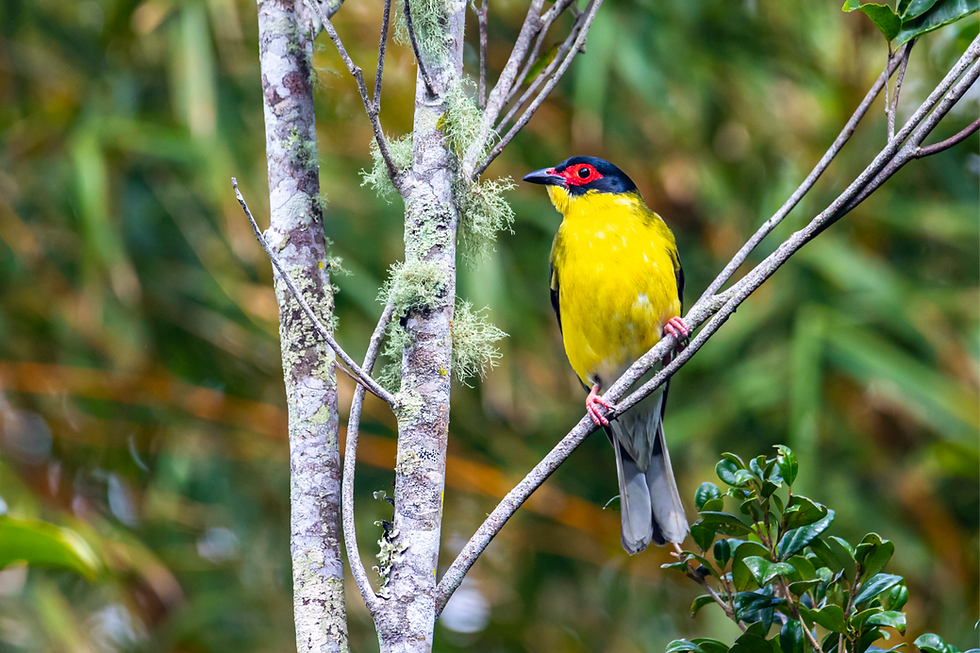
Observations of birds bathing in dew-laden foliage in Far North Queensland
Scott Campbell Morrison
Bathing in dew-laden foliage (also known as dew bathing) is a recognised behaviour, but documentation of it is scarce. I observed dew bathing by five bird species at Koah in north Queensland, and by one additional species at Broome in Western Australia. On two occasions the behaviour was prolonged and social, but there are no consistencies that suggest a general explanation for the behaviour.
pp. 105-108
Image credit: AdobeStock